EducationalJanuary 1, 20263 min read
Ethics Series Volume 1: Plato's Fiduciary
Plato believed most people live in shadows. What does that say about financial advisors today in the context of being fiduciaries?
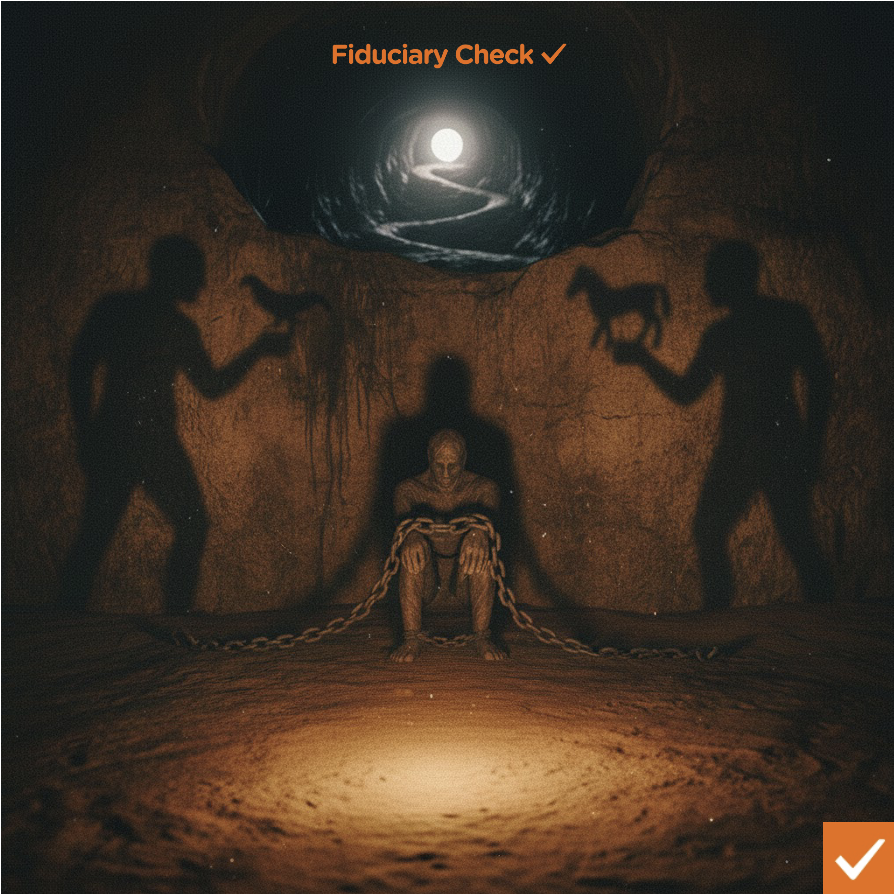
Plato suggests in his 4th century BC work, the Republic, that there are three types of people in the world. The first are those who are mistaken about things. The second are people who are either unwilling or unable to pursue the truth. The last are those who wish to know the truth. I won’t ascribe the percentages of the three groups above to that of financial advisors, but how many fall in the third category?
What is to be said about an advisor that wishes to know the truth, but willfully ignores it to pursue riches or prestige? Does willful ignorance constitute a distinct ethical failure beyond Plato’s categories? Are the fourth group of advisors the ones that can only truly be unethical in nature? Or are these advisors in the second category because they sell false narratives to unknowing people?
In Plato’s Allegory of the Cave, he describes a story of prisoners that are born chained in darkness and believe the shadows they see are speaking. The shadows are in fact people and objects out of sight that speak amongst each other illuminated by a fire. The prisoners are framed as ignorant because they are ascribing the shadows to be reality but are limited by the chains that bind them from revealing the truth. Escaping imprisonment is daunting and frightening for those bound, but it is the path to seeing the truth. Most important of all, those who escape bear the responsibility to return and enlighten the rest.
The metaphorical lack of return in relation to financial advisors are those who fall in the fourth (or second) category explained earlier. They are the people who strove for greater knowledge, but chose to conceal truth for personal gain.
Information asymmetry is unavoidable in any and every context. A mother will always know more than her newborn. A money manager will always know more about managed futures than a high school English literature teacher. Is it the financial advisor’s duty to narrow the gap of informational asymmetry? Does the engagement and outsourcing of financial management to the advisors infer that the gap should not be narrowed? Does the client actually care to know certain nuances or undeniable truths about capital markets? Some do, some don’t. But for the clients that do care, they should be handled accordingly and not led astray. Fiduciaries are those who carry the torch back into the cave, guiding others toward truth.


Found this useful? Pass it on.
Keep reading
Related articles
R
EducationalSep 25, 202610 min read
Roth Conversions Before Retirement: When They Can Save You Money (and When They Don't)
Many of the pre-retirees I meet in The Woodlands and across Greater Houston have done exactly what they were told to do....
C
EducationalSep 18, 202613 min read
Can You Retire With $1 Million? What a Fee-Only Financial Planner Would Analyze
The question almost always arrives the same way. Someone in their late fifties sits down across from me, slides over a 4...
F
EducationalSep 10, 20269 min read
Financial Planning After 50: The Decisions That Matter Most for Houston-Area Professionals and Business Owners
Once you turn 50, the financial planning conversation changes shape. You're no longer just accumulating — you're sequenc...